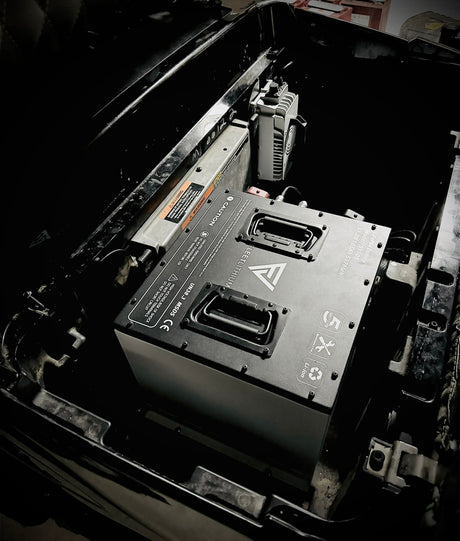
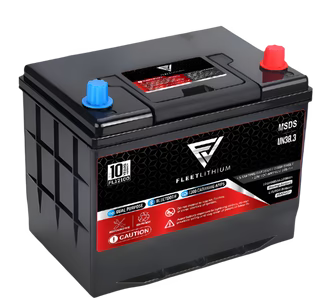
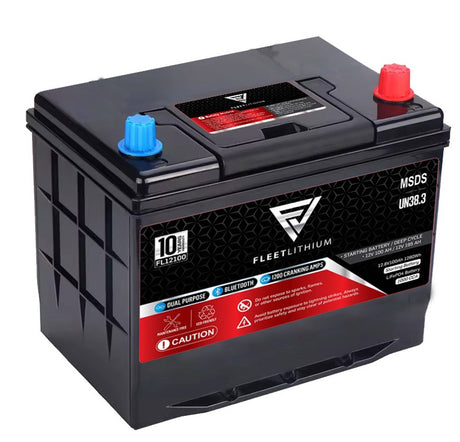
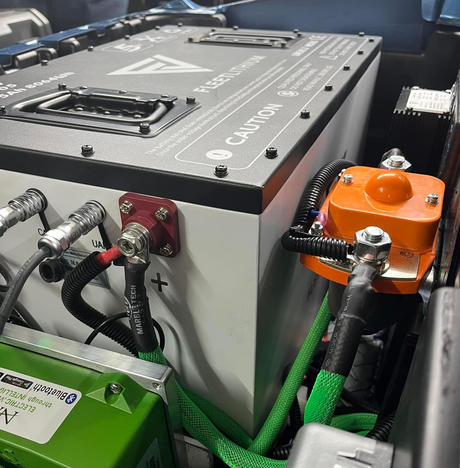
Can you convert a Yamaha golf cart to lithium?
Yes. A compatible Yamaha electric golf cart or utility vehicle can use a Fleet Lithium conversion kit matched to its original voltage, tray and control system. Start with your model and battery labels: older 36V carts use the Classic guide, G19/G22 use the Legacy 48V guide, Drive/G29 and Drive2 share the Drive guide, and verified passenger/utility models use their own 48V guide.
A tired lead-acid bank can turn a useful Yamaha into a cart you hesitate to take out. A well-matched lithium conversion simplifies battery upkeep and lets you choose the reserve you need for your usual trips. The important part is matching the complete system, from the mounting hardware to the charger and accessory supply.
Download the right Yamaha installation manual
Related models share a manual, with the differences called out inside. These guides cover compatible lead-acid electric conversions. They are not gas-to-electric conversion instructions or factory-lithium replacement procedures.
| Manual group | Models and scope | Download |
|---|---|---|
| Yamaha Classic 36V | G1E / G2E / G5E / G8E / G9E / G14E / G16E | Download PDF |
| Yamaha G19 / G22 48V | G19E / G22E | Download PDF |
| Yamaha Drive / Drive2 48V | DRIVE / G29 / DRIVE2 - ELECTRIC LEAD-ACID | Download PDF |
| Yamaha Passenger / Utility 48V | CONCIERGE / ADVENTURER / UMAX / UMX | Download PDF |
Each PDF includes a manually drawn lead-acid series diagram, replacement-system power flow, model-specific checks, troubleshooting and a fillable installation record. The 48V manuals also explain the matched two-pack 210Ah arrangement. Diagrams identify electrical relationships; the supplied hardware instructions establish exact mounting and terminal details.
Why choose Fleet Lithium for your Yamaha?
- Less routine battery work. LiFePO4 does not require watering, acid-level checks or lead-acid equalization charging.
- Capacity suited to your day. Match energy reserve to distance, passengers, hills and opportunities to charge.
- Useful battery information. Use the matched Fleet SOC display and supported monitoring features instead of relying on an old lead-acid voltage gauge.
- A coordinated conversion. Order the battery configuration with the matched lithium charger, model-specific mounting hardware and required installation components.
- Support with the details. Fleet can use your model label, controller label and before photos to help identify the right application.
Regular checks of cables, restraint and connectors still matter. Review the current Fleet warranty terms for your selected battery.
Is your Yamaha 36V or 48V?
Count the complete bank and read the voltage on each battery. Six batteries do not always mean the same system: six 6V batteries total 36V, while six 8V batteries total 48V. Eight 6V or four 12V batteries also total 48V when connected in series.
Yamaha's OEM documentation identifies six 6V batteries for G16E, six 8V for G19E/G22E and G27E, and eight 6V for G23E and current UMAX 2/UMX AC examples. Drive/G29 layouts vary by version; some early cars use four 12V batteries, while later Drive and Drive2 examples use six 8V batteries. Verify your vehicle against the Yamaha owner-manual library; a modified cart may differ from its original specification.
Fleet's 36V-class conversion uses 38.4V nominal lithium; its 48V-class conversion uses 51.2V nominal lithium. The names describe compatible system classes. They do not make the batteries or chargers interchangeable. The current 36V Fleet charger is listed at 43.2V DC / 15A, while the 48V conversion charger is 58.4V DC / 18A. Always match the actual battery and charger labels.
Yamaha Classic 36V: choose your kit and manual
A 36V conversion keeps your Yamaha in its original voltage class. It is not a 36V-to-48V performance upgrade. G3E and other unlisted classics need a separate mounting and control-circuit fitment check before using this procedure.
Early Yamaha controls can differ substantially from later electronic-controller systems. Identify the voltage required by every small wire and solenoid coil. A wire formerly attached midway through the lead-acid bank is a battery tap; never move it to full pack voltage without the correct interface. Keep resistor, accelerator and direction-control circuits in their original approved configuration.
Shop the matched model: G1E 1980-1986 36V · G2E 1985-1991 36V · G5E Sun Classic 1991-1992 36V · G8E · G9E · G14E Ultima 1995-1996 36V · G16E 1996-2002 36V
FL-IM-YAM-36 · Revision 1.0 · 7 pages · Owner record included.
Yamaha G19 / G22 48V: choose your kit and manual
Both models use a six-battery 48V lead-acid bank in Yamaha documentation, but their mounting hardware and control circuits must be matched individually. A common voltage does not make their brackets interchangeable.
Record the controller label and the small wires at the original battery bank and charger receptacle. Preserve key/enable, reverse warning and charging interlock functions. Use the interface supplied for the exact G19E or G22E; a plug that fits is not proof of a correct pinout. Do not substitute the other model's wiring diagram.
Shop the matched model: G22 (2003-2007) (48V) · G19 (1999-2003) (48V)
FL-IM-YAM-G19G22 · Revision 1.0 · 8 pages · Owner record included.
Yamaha Drive / Drive2 48V: choose your kit and manual
The Drive name, body shape or model year alone does not identify the controller or battery generation. Read the vehicle, motor/controller and battery labels. Gas, factory-lithium and already modified conversions are outside this procedure.
Drive and Drive2 include different AC/DC controllers and charger interfaces. Record the actual controller model; do not assume every G29 uses a GE controller or every Drive2 uses the same AC system. Preserve charging inhibit and normal regenerative braking where fitted. Any calibration changes need the approved specification for that controller and Fleet pack.
Shop the matched model: Drive G29 (2007-2016) 48V · Drive2 (2017–Present) 48V
FL-IM-YAM-DRIVE · Revision 1.0 · 8 pages · Owner record included.
Yamaha Passenger / Utility 48V: choose your kit and manual
UMAX, Rally, Bistro and Range Picker names alone do not prove lead-acid electric fitment. Gas/EFI and factory-lithium models are excluded. For Bistro, Range Picker, unidentified UMAX variants or modified equipment, obtain exact model/serial fitment confirmation before ordering or dismantling.
Passenger and work vehicles may carry lighting, radios, equipment, converters and auxiliary batteries beyond the traction system. Identify each supply separately. Never merge a separate auxiliary circuit into the traction pack by assumption. Preserve charging inhibit and regenerative braking where fitted; record the actual controller and converter labels.
Shop the matched model: Adventurer (All Years) (48V) · UMAX Rally 2018-2025 48V · UMAX Rally 2+2 2019-2025 48V · G23E UMAX Medium Duty I 2004-2007 48V · G27E UMAX Light Duty 2004-2007 48V · UMX Electric J0H 2020-2026 48V · Concierge (All Years) (48V) · Drive2 Adventurer Super Hauler 2024-2026 48V · UMAX 2018-2026 48V
FL-IM-YAM-UTILITY · Revision 1.0 · 8 pages · Owner record included.
Choose capacity around use, not a promised mileage number
The Classic 36V kits currently offer a 105Ah configuration with 4.03 kWh nominal energy. Most listed 48V Yamaha kits offer 65Ah, 105Ah, 168Ah and paired 210Ah; the G22 listing offers 105Ah, 168Ah and 210Ah. Check your exact product listing and physical fit.
| Capacity | Arrangement | Nominal energy | Best considered for |
|---|---|---|---|
| 65Ah | One battery | 3.33 kWh | Lighter use; stock motor/controller only |
| 105Ah | One battery | 5.38 kWh | Everyday use with regular recharging |
| 168Ah | One battery | 8.60 kWh | More reserve in a single-pack system |
| 210Ah | Two matched 105Ah batteries in parallel | 10.75 kWh | The greatest listed reserve, with approved paired fitment |
Nominal energy = voltage × Ah ÷ 1,000. These figures are not measured usable energy or guaranteed driving range.
At the same voltage, 168Ah has 60% more nominal energy than 105Ah. The 210Ah pair has twice the nominal energy. Hills, passengers, towing, tires, speed, accessories and temperature affect how quickly you use that reserve. More battery capacity does not increase Yamaha's passenger, payload, towing or speed ratings.
Yamaha lithium installation: the practical sequence
Use your matching PDF with the battery, mounting-kit and vehicle instructions. Have an appropriately trained EV service provider complete work beyond your experience.
1. Record the original system
Photograph the whole bank, main leads, charger connections, small control wires and accessory feeds. Save vehicle, controller and converter labels. On older 36V models, pay particular attention to solenoid/control voltage and wires connected midway through the old bank. On work vehicles, identify separate auxiliary batteries and equipment supplies.
2. Secure, isolate and remove
Park level, apply the brake, chock the wheels, unplug charging power and remove the key. Select TOW where fitted and follow Yamaha's exact isolation and discharge procedure. Early classics may not have a Tow/Run switch. Support a raised cargo bed using its approved restraint. Battery terminals remain live even with the key removed.
After isolation, disconnect and insulate the main negative lead first, then the main positive. Identify every additional feed before removing inter-battery links. Use appropriate lifting equipment and arrange recycling; repair a damaged tray before installing the replacement.
3. Mount the correct Fleet arrangement
Match the mounting hardware to the model, actual tray and selected capacity. Check clearance, service access, cable routing and moving-part travel. Use the specified attachment points and torque. Do not drill a frame rail or modify a battery case to force a fit.
4. Restore power, accessories and controls
With the Fleet battery OFF and the vehicle isolated, use correctly rated cables, protection, precharge and the specified terminal stack-up. Verify polarity. Keep 12V accessories on a compatible converter with suitable output capacity. Preserve charging inhibit and normal braking functions. Do not move a former battery tap to full pack voltage or bridge a control wire to clear a no-drive condition.
5. Install the lithium charger and display
Mount the matched charger in its approved protected, ventilated location. Check the AC input label for your local supply, secure the inlet and connect the matching SOC harness. Prevent accidental use of the lead-acid charger. Never assume two similar plugs have the same electrical function.
6. Charge, test and keep a record
Complete the manual's pre-power checklist and follow the specified power-up sequence. Check pack status, accessory operation and faults, then complete a normal full charge. Unplug AC before driving and perform a controlled low-speed test. Verify normal braking and reinspect restraint and wiring. For 210Ah, verify both packs contribute.
Yamaha lithium conversion FAQs
Can I convert my Yamaha golf cart to lithium?
Yes, when the Fleet kit matches your electric vehicle, original voltage, battery tray and control system. Choose the Classic 36V, G19/G22 48V, Drive/Drive2 48V or Passenger/Utility 48V manual. Gas and factory-lithium vehicles need a different solution.
Is my Yamaha a 36V or 48V cart?
Read the vehicle and battery labels and count the complete series bank. Six 6V batteries total 36V. Six 8V, eight 6V or four 12V batteries total 48V. Battery count alone is not enough. Do not infer voltage from the body style.
Why does a 36V Yamaha use a 38V Fleet battery?
The current Fleet 36V-class conversion uses a 38.4V nominal LiFePO4 pack. It retains the original vehicle voltage class. Its listed matched charger is 43.2V DC and 15A. A 51.2V pack and 58.4V charger are not substitutes for this 36V system.
Why does a 48V Yamaha use a 51V Fleet battery?
The Fleet 51V class is 51.2V nominal LiFePO4 for compatible 48V vehicles, with a matched 58.4V lithium charger. Compatibility still depends on the exact controller, interfaces and accessories.
Do all Yamaha Drive and Drive2 carts have the same controller?
No. The Drive families include different AC and DC systems. Identify the actual controller and calibration. Do not assume every G29 uses a GE controller or that every Drive2 has the same AC controller.
Can I use the original lead-acid charger?
Use the matched Fleet lithium charger supplied for your battery. Prevent accidental use of the old charger and preserve the vehicle charging interlock through the approved interface. Similar plugs do not establish matching polarity or pinout.
Is the 210Ah Yamaha kit one battery?
The 210Ah configuration uses two matched 51.2V 105Ah packs in parallel. Capacity totals 210Ah while voltage remains 51.2V nominal. Use the approved matching procedure, harness and protection; never connect these packs in series.
Will lights and accessories work after conversion?
They need the correct supply. Verify converter input range, output capacity, enable wiring, returns and branch fuses. A former tap on part of the lead-acid bank cannot simply move to full lithium pack voltage. Never connect a 12V device directly across the traction battery.
Does the utility manual cover every UMAX, Bistro and Range Picker?
No. It covers compatible, verified 48V lead-acid electric variants. The family name alone does not prove fitment. Gas/EFI and factory-lithium versions are excluded. Send model, serial number, battery-bank and controller photos for unidentified variants, Bistro or Range Picker before ordering.
How long does a Yamaha lithium installation take?
Time depends on the vehicle condition, battery removal, tray repairs and control/accessory interfaces. Allow time for the first full charge, low-speed testing and reinspection. A quick physical battery swap is not a completed installation.
Can I use these instructions for a factory-lithium Yamaha?
No. Factory-lithium replacement can require different communication, mounting and charging interfaces. Identify the original battery system and ask Fleet for the matching replacement procedure.
Where do I download the Yamaha installation manuals?
Choose the matching group in this guide or visit the Fleet Lithium download library. Each PDF includes model notes, original diagrams, installation checks, troubleshooting and a fillable owner record.
Make your next Yamaha battery replacement count
Choose the right voltage class, enough reserve for your usual trips and the mounting kit for your actual model. Start with the model groups above, or send Fleet your vehicle label, battery-bank photos and controller label for help.