How Long Do Golf Cart Batteries Last?
The short answer: a set of flooded lead-acid golf cart batteries typically lasts 3 to 5 years with good maintenance, while a lithium golf cart battery pack commonly lasts 8 to 12 years or more. The difference comes down to chemistry, depth of discharge, and maintenance. Lithium iron phosphate (LiFePO4) cells simply cycle far more times than lead-acid plates can, and they demand far less care along the way.
Below we break down real-world lifespans by battery type, the habits that shorten (or extend) battery life, the warning signs of a dying set, and how to decide when an upgrade is worth it.
Average Golf Cart Battery Lifespan by Type
| Battery Type | Typical Lifespan | Typical Cycle Life | Maintenance |
|---|---|---|---|
| Flooded lead-acid | 3–5 years | ~500–700 cycles | High — watering, cleaning, equalizing |
| AGM (sealed lead-acid) | 4–6 years | ~600–800 cycles | Moderate |
| Lithium (LiFePO4) | 8–12+ years | 2,000+ cycles | None — sealed, self-managing |
These ranges match what independent battery industry sources report for golf cart applications: lead-acid in the 3-to-5-year band and lithium in the 8-to-12-year band, with cycle counts of roughly 500–700 for lead-acid and 2,000-plus for lithium (Impact Battery; Continental Battery). How often you drive and how well you charge matters as much as the chemistry itself.

Why Lead-Acid Batteries Wear Out Sooner
Flooded lead-acid packs are the traditional choice, and they are affordable up front. But they carry built-in disadvantages that shorten their service life:
- Shallow usable capacity. A lead-acid battery should not be discharged below roughly 50% of its rated capacity. Repeated deep discharges accelerate plate sulfation — the leading cause of early failure.
- Watering and corrosion. Flooded cells vent water during charging and need distilled-water top-ups, terminal cleaning, and periodic equalize charges. Missed maintenance directly shortens lifespan.
- Weight. Six or eight heavy 6V/8V batteries add hundreds of pounds, which increases the load on every discharge cycle.
- Slow recharge. Lead-acid needs a long, multi-stage charge. Carts put away partially charged sulfate faster and lose capacity sooner.
Most lead-acid packs that die early were not abused mechanically — they were under-watered, under-charged, or left sitting discharged.

Why Lithium Golf Cart Batteries Last Longer
Lithium iron phosphate chemistry is built for deep cycling. A properly engineered lithium golf cart battery pack lasts several times longer than lead-acid for four main reasons:
- Deep discharge without damage. LiFePO4 cells can routinely use most of their rated capacity every cycle without the sulfation penalty lead-acid suffers.
- Thousands of cycles. Quality LiFePO4 cells are rated for 2,000+ full cycles — years of daily rounds or job-site shifts.
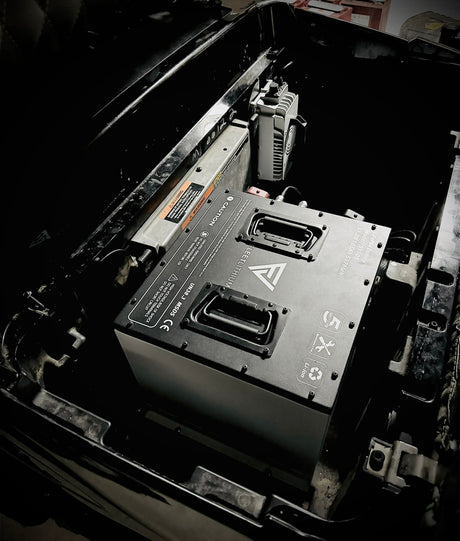
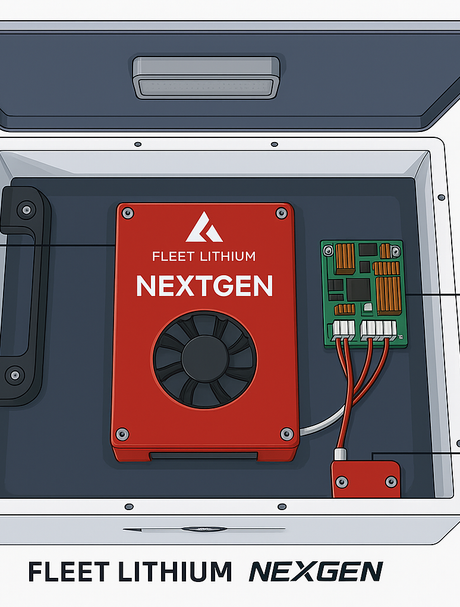
- A battery management system (BMS). A built-in BMS balances every cell, prevents over-charge and over-discharge, and cuts power on faults. Fleet Lithium kits ship with the NexGen BMS, rated for 300A continuous / 800A peak surge discharge, so the pack protects itself the entire time it runs your cart.
- Zero maintenance. No watering, no terminal corrosion, no equalize charges. Charge it and drive.
One caveat applies to all lithium: avoid charging in extreme sub-freezing conditions. Quality packs include low-temperature charge protection — another job the BMS handles automatically.
Signs Your Golf Cart Batteries Need Replacing
Battery packs rarely fail without warning. Watch for these symptoms:
- Shorter runtime. The clearest sign — the cart that once ran 18+ holes or two full days now needs a charge by lunch.
- Sluggish acceleration and slower top speed. Worn cells sag under load, especially on hills.
- Longer charge times. A pack that charges for hours and never quite tops off has lost usable capacity.
- Heavy water use and corroded terminals. On lead-acid, cells drinking water constantly or crusting over are deteriorating.
- Bulging or swelling cases. Stop using the pack immediately and replace it — this is a safety issue.
If your lead-acid set is showing two or more of these and is past its fourth season, replacement usually makes more sense than rescuing it.
How to Make Golf Cart Batteries Last Longer
Whichever chemistry you run, these habits add seasons of life:
- Recharge after every use. Never store a cart with a partially charged pack for long stretches.
- Don't leave a pack sitting dead. A discharged pack self-discharges further and degrades fast.
- Keep it cool and dry. Extreme heat accelerates wear on lead-acid; store the cart out of direct sun when possible.
- For lead-acid owners: check water levels monthly, keep terminals clean and tight, and equalize on schedule.
- For lithium owners: almost nothing to do — just avoid charging below freezing and use the manufacturer's charger.

When Upgrading to Lithium Is Worth It
Compare cost per year, not sticker price. A lead-acid set that lasts 4 years and a lithium pack that lasts 12 can look similar in total spend — but lithium also adds lighter weight, faster charging, more usable capacity per charge, and zero maintenance hours. Most owners who run their carts daily or commercially see the upgrade pay for itself well before the pack's warranty ends.
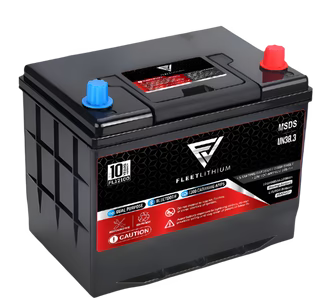
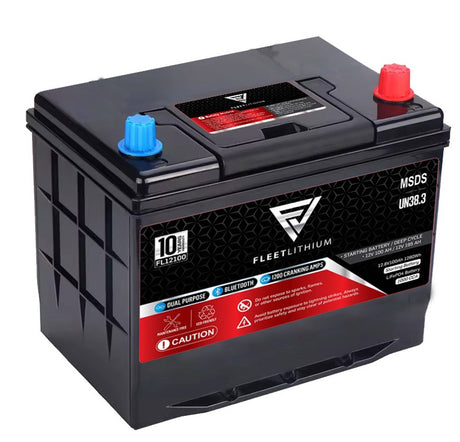
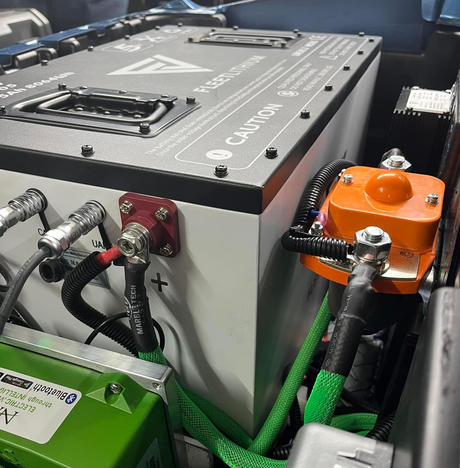
Fleet Lithium conversion kits for Golf / LSV / UTV applications carry a 10-year warranty — coverage that outlasts two or three lead-acid replacements. Browse the Golf / LSV / UTV lithium battery kits to find a drop-in pack matched to your voltage, or read our step-by-step guide to replacing lead-acid with lithium before you order.
The same math applies outside the golf course: our marine deep-cycle batteries and solar and off-grid batteries use the same long-life LiFePO4 chemistry.
Frequently Asked Questions
How long do lithium golf cart batteries last?
Typically 8 to 12 years or more, or 2,000+ charge cycles. Fleet Lithium golf cart conversion kits are backed by a 10-year warranty.
How long do lead-acid golf cart batteries last?
Three to five years on average with regular watering and proper charging — less if the pack is repeatedly deep-discharged or left uncharged.
How many years is a golf cart battery good for?
A well-maintained flooded lead-acid set is usually good for 3 to 5 years; AGM batteries 4 to 6; lithium 8 to 12 or more.
Do lithium batteries really last longer than lead-acid in a golf cart?
Yes. LiFePO4 cells tolerate deep discharges and deliver several times more charge cycles, so a lithium pack commonly outlives two or three lead-acid sets.
Can I make my lead-acid batteries last as long as lithium?
No. Good care gets lead-acid to the top of its 5-year range, but the chemistry's cycle limit is physical. If your pack is aging, the practical choice is replacement — and lithium is the replacement that ends the maintenance cycle for good.