Can you convert a Polaris Ranger EV to lithium?
Yes. A compatible factory lead-acid Polaris Ranger EV can be converted from its 48V battery bank to a Fleet Lithium 51.2V LiFePO4 system. Choose 105Ah, 168Ah or a matched dual-pack 210Ah bundle, use the correct lithium charger, and confirm your vehicle’s mounting, 12V accessory supply and charging interlock before installation. This guide does not cover factory Li-Ion Rangers or the Ranger XP Kinetic.
Your Ranger earns its place on the property. Replacing a tired lead-acid bank is an opportunity to spend less time watering batteries and more time using your vehicle. A properly matched Fleet Lithium conversion brings your battery, charger and state-of-charge display together in one bundle, with capacity choices for different workloads.
Use this guide to compare the options, understand what the conversion involves and prepare for a successful installation.
Which Polaris Ranger EV models can use this kit?
Start with the original battery system, then confirm the VIN and model year. The Fleet Lithium Ranger EV bundle is intended for compatible Rangers originally fitted with a 48V lead-acid system. The factory bank contains eight 12V batteries: two parallel strings of four batteries connected in series.
The product listing covers 2010–2024, but a year alone does not establish compatibility. Factory Li-Ion models, the XP Kinetic, vehicles from different markets and previously modified Rangers need separate identification. Before ordering, send Fleet Lithium your VIN/model label and clear photos of the battery compartment, charger label and existing connections if you are unsure.
Ask Fleet Lithium to confirm your Ranger EV fitment.
Why upgrade your Ranger EV to Fleet Lithium?
- Leave battery watering behind. LiFePO4 batteries do not need electrolyte top-ups or lead-acid equalization charging.
- Choose your energy capacity. Three bundle options let you plan around your routes, payload, terrain and opportunities to recharge.
- See your remaining charge. The supplied digital SOC gauge and supported Bluetooth monitoring help you keep track of the battery.
- Prepare for cold-weather charging. Current NexGen packs include internal heating for cold charging conditions. The heater operates as part of charging; it is not a heater for driving.
- Buy a matched system with support. The Ranger bundle combines the selected battery configuration, lithium charger and listed installation components. Fleet’s published EV battery warranty is 10 years: five years of full replacement coverage followed by five years of prorated coverage, subject to the warranty terms and registration requirements.
The benefit is easier day-to-day battery ownership. You should still inspect cables, connections and mounting, and follow the charging and storage instructions.
105Ah vs. 168Ah vs. 210Ah: which Ranger EV battery should you choose?
All three options operate at 51.2V nominal. The capacity changes how much energy you can carry. The 210Ah option uses two matched 105Ah batteries in parallel; it is not a higher-voltage conversion.
| Bundle | Configuration | Nominal energy | Consider it when… |
|---|---|---|---|
| 105Ah | One 105Ah battery | 5.38kWh | You want the lowest-cost option in this range and can recharge between shorter work periods. |
| 168Ah | One 168Ah battery | 8.60kWh | You want more energy capacity in a single-pack configuration. |
| 210Ah | Two matched 105Ah batteries in parallel | 10.75kWh | You need the highest capacity offered in this Ranger bundle and can accommodate the approved dual-pack installation. |
Nominal energy = 51.2V × amp-hours ÷ 1,000. These figures describe stored energy, not guaranteed usable energy or driving range.
Compared with 105Ah, the 168Ah option carries 60% more nominal energy and the 210Ah option carries twice as much. Actual miles per charge depend on hills, cargo, tire condition, speed, temperature and accessory loads. Give yourself a reserve for the return trip rather than sizing around an ideal maximum-range claim.
Compare current Ranger EV bundle prices and select your capacity.
What is included in the Fleet Lithium Ranger EV bundle?
The current bundle listing includes:
- Your selected 51V NexGen LiFePO4 battery configuration.
- CH5618 lithium charger, rated at 58.4V DC and 18A output.
- Digital state-of-charge gauge.
- AC0219 AC power inlet.
- CB0917 1/0 AWG main cable set, 35.4 inches (approximately 899mm).
- BR3110 vehicle mounting kit where required, with the applicable mounting hardware.
Check your order and supplied instructions against the parts in the box. Confirm the mounting arrangement, terminal torque and charger interface for your exact battery and Ranger before taking the original bank apart. The dual-pack option also requires Fleet’s approved parallel connection and protection arrangement.
How does a Polaris Ranger EV lithium installation work?
The conversion involves the complete battery and charging system: identify the vehicle, isolate power, remove the old bank, secure the new pack, connect the approved electrical interfaces, then check charging and vehicle operation.
This overview helps you plan the job. Use your model-specific Polaris instructions and the Fleet instructions supplied for your kit for the actual procedure. Polaris’s 2022 Ranger EV main power connector guidance directs owners to an authorized service facility for electrical service; check the requirements for your own vehicle.
1. Confirm the vehicle, kit and work area
Record your VIN, battery serial number and selected capacity. Photograph and label the existing connections. Arrange suitable lifting help for the lead-acid batteries, insulated tools, eye protection and a torque wrench appropriate to the supplied specifications. Plan approved recycling for the removed batteries.
2. Isolate power before removal
Park securely, disconnect external charging power and follow the Polaris main power connector and fuse isolation procedure for your model. Turning the key off does not isolate the battery system. Cable identification and safe isolation must be complete before the original bank is removed.
3. Prepare the compartment and secure the battery
Inspect the tray and surrounding structure for corrosion or damage. Install the approved restraints for your selected capacity, keeping the battery, terminals and cables clear of seat movement, the cargo bed, sharp edges and hot components. Do not infer a drilling pattern or fastener torque from a photograph.
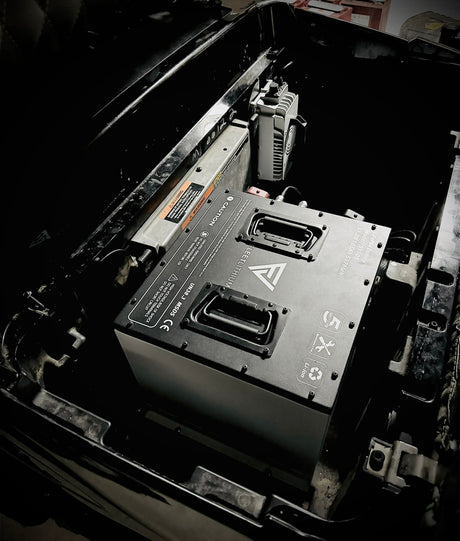
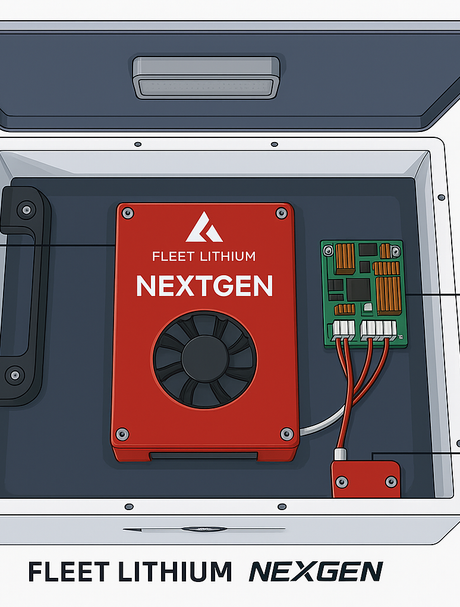
The photograph at the top of this article shows a real Fleet Lithium Ranger installation. Component generations and mounting details can differ from your supplied kit.
4. Connect the battery, 12V supply and charger interface
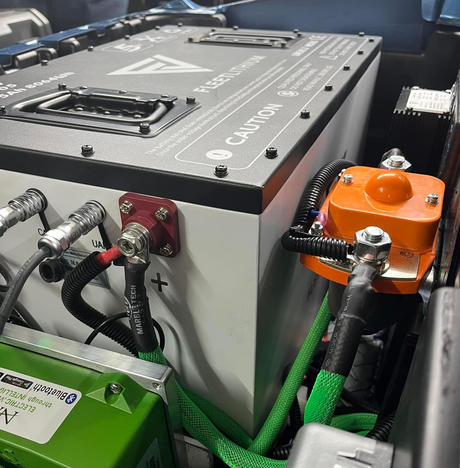
Use the kit-specific cable routing, polarity, protection and terminal torque instructions. Your lights and other 12V accessories need the correct DC-DC supply; they must not be connected directly to the 51.2V traction battery.
Early Rangers deserve particular attention. Some 2010 vehicles combine the 12V converter with the original charger, while later arrangements can use a separate converter. Identify what your Ranger actually has before removing charging hardware. Preserve the approved charging interlock: do not improvise jumpers, bypass the inhibit circuit or copy another battery brand’s wiring changes.
For 210Ah, use only the matched pair and Fleet-approved parallel procedure. Connecting two 51.2V batteries in series would create the wrong voltage for this conversion.
5. Check the system before driving
Verify secure mounting, protected terminals, cable clearance and correct polarity before restoring power in the prescribed sequence. Check the SOC display, 12V accessories, charger operation and charging interlock. Complete the required first charge and a controlled low-speed test, then reinspect the installation. Stop and contact Fleet if you see faults, abnormal heat or unexpected behavior.
Charging and caring for your converted Ranger EV
Use the matched lithium charger. Do not charge the Fleet pack with the original lead-acid charger. A similar-looking plug does not establish a compatible charging profile. Check both the battery and charger labels, and follow the supplied AC connection instructions.
The CH5618’s 18A output gives a simple planning estimate: battery amp-hours divided by 18. That is about 5.8 hours for 105Ah, 9.3 hours for 168Ah and 11.7 hours for 210Ah from empty at a constant 18A. Real charging takes longer when current tapers, balancing or heating is needed, or other loads are present. A partial recharge is shorter; these are calculations, not promised charge times.
In cold conditions, allow the battery’s heating and BMS controls to manage charging. Never bypass a charging lockout. Before extended storage, follow the current Fleet user manual for state of charge, battery shutdown and accessory-load isolation. Keep the installation record and purchase information with your vehicle documents.
Printable installation resource
Download the Polaris Ranger EV installation manual
Keep the illustrated guide beside your vehicle records. It includes fitment and capacity guidance, manually drawn functional wiring diagrams, a real installation photograph, first-use checks, troubleshooting and a fillable installation record.
Current edition: Revision 1.0. Use this manual alongside the instructions supplied with your battery, mounting hardware and vehicle. Check the exact kit specifications before starting.
Polaris Ranger EV lithium conversion FAQs
Why is a 51V battery used in a 48V Ranger EV?
“48V” identifies the vehicle’s original lead-acid system class. Fleet’s compatible LiFePO4 pack is 51.2V nominal and is sold as 51V. Battery voltage, BMS capability, charging profile and vehicle compatibility must all match; voltage labels alone are not enough.
Does this kit fit a factory lithium Ranger or XP Kinetic?
No. This guide and bundle are for compatible factory lead-acid Ranger EV vehicles. Do not use them as conversion instructions for factory Li-Ion Rangers or the XP Kinetic.
Can I keep the original Ranger EV charger?
Do not use the original lead-acid charger to charge the Fleet lithium pack. Use the matched CH5618 charger and confirm how your original charger’s 12V and interlock functions will be handled.
Will the larger battery make my Ranger faster?
Additional amp-hours increase nominal energy capacity. They do not establish a new top speed or increase the vehicle’s rated payload or towing limits.
How long does a Ranger EV lithium conversion take?
There is no reliable universal installation time. Battery removal, tray condition, mounting, charger interfaces and testing vary by vehicle and selected bundle. Allow time to complete the checks and resolve any missing kit-specific instructions before energizing the system.
Can I add a second battery later?
Contact Fleet before expanding an existing system. Battery generation, capacity, condition, voltage matching, cable protection and BMS/display compatibility all matter. Use an approved matched arrangement.
What should I send Fleet if I need installation help?
Send your VIN/model label, order number, battery and charger labels, selected capacity, and clear photographs of the mounting and cable connections. Include any gauge or app fault message. Contact Fleet Lithium support before changing wiring to clear a fault.
Give your Ranger a battery system built around your day
Choose the capacity that suits your property, workload and charging routine. Fleet Lithium brings the battery, matched charger, monitoring and support together so you can plan the conversion with the right information from the start.