Can you convert a Bintelli Beyond to lithium?
Yes. A compatible Bintelli Beyond with a factory 48V lead-acid battery system can use Fleet Lithium’s 51.2V conversion kit, matched lithium charger and vehicle-specific mounting hardware. Choose 65Ah, 105Ah, 168Ah or two matched 105Ah packs for 210Ah. Start by identifying your actual battery bank, controller and 12V supply; the Beyond name and passenger count do not establish every detail of the installation.
Replacing a tired lead-acid bank is an opportunity to simplify ownership and choose the energy reserve that suits your day. This guide explains the kit options, the important Beyond-specific checks and the installation sequence, with a printable manual you can keep with your cart.
First, confirm which Bintelli Beyond you own
The Fleet listing covers the Beyond 48V conversion application, including listed 2-, 4- and 6-passenger models. This guide applies to compatible lead-acid vehicles. It is not a replacement procedure for a factory-lithium Beyond, Bintelli Nexus or Nemesis. For those vehicles, send Fleet your model, serial number and battery photos for the correct fitment instructions.
Beyond battery arrangements vary. Bintelli’s OEM user manual illustrates both six- and eight-battery lead-acid layouts. Its 2023 four-passenger parts manual also lists eight 6V batteries. Count the complete bank and read the labels on your cart instead of choosing from seat count or a single photograph.


Real before photographs: Bintelli Beyond User Manual, 2024 web edition, PDF page 12. These identify original layouts; they are not Fleet mounting instructions.
Six 8V batteries in series total 48V. Eight 6V batteries in series also total 48V. Photograph main power cables, small control wires, charger connections and accessory feeds before removing anything. If the labels or wiring do not match the selected kit, resolve that first.
Why upgrade your Beyond to Fleet Lithium?
- Simpler battery upkeep. LiFePO4 does not require watering or lead-acid equalization charging.
- A choice of energy reserve. Pick capacity around your usual distance, passengers, terrain and opportunities to recharge.
- Useful charge information. The matched SOC display and supported Bluetooth monitoring provide battery information beyond a lead-acid voltage gauge.
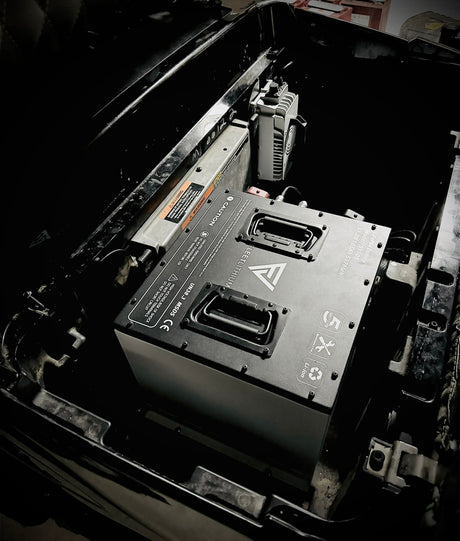
- A coordinated conversion system. The Fleet kit brings together the battery configuration, lithium charger, listed Beyond mounting hardware, cables and display.
- Support when you need it. Fleet can review your component labels and installation photos when helping you identify the correct kit and interfaces.
Keep normal cable and mounting inspections in your routine. Review the current Fleet warranty terms as part of your purchase decision.
65Ah, 105Ah, 168Ah or 210Ah?
All four choices use the same 51.2V nominal lithium voltage class. More amp-hours provide more stored energy; they do not increase the cart’s original passenger, load or speed limits.
| Capacity | Configuration | Nominal energy | Choose it for |
|---|---|---|---|
| 65Ah | One pack | 3.33 kWh | Lighter use with a stock motor and controller only. |
| 105Ah | One pack | 5.38 kWh | Everyday use with regular opportunities to recharge. |
| 168Ah | One pack | 8.60 kWh | More reserve between charges in a single-pack arrangement. |
| 210Ah | Two matched 105Ah packs in parallel | 10.75 kWh | The greatest listed capacity, with the approved paired installation. |
Calculated nominal energy = 51.2V × Ah ÷ 1,000. These are stored-energy figures, not guaranteed driving ranges or usable-energy measurements.
A 168Ah system carries 60% more nominal energy than 105Ah; 210Ah carries twice as much. Full passenger loads, hills, tire choice, higher speeds, accessories and cold weather can use that reserve more quickly. Confirm physical fit and electrical demand for your configuration before selecting a capacity.
What comes in the Fleet Bintelli kit?
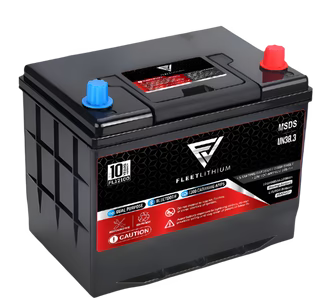
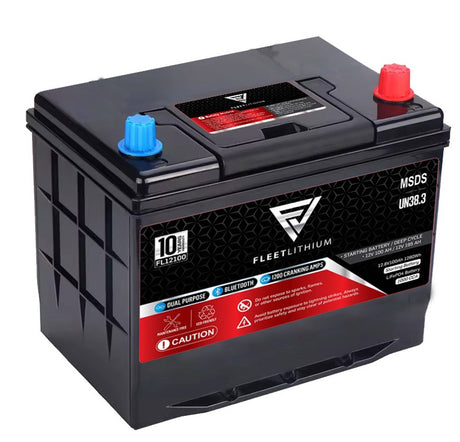
The current Beyond conversion kit lists your selected Fleet LiFePO4 battery configuration, the BR1324 Beyond mounting kit, a CH5618 58.4V / 18A lithium charger, AC0219 AC connector, CB0917 main cables listed at 35.4 inches, a digital SOC gauge and mounting hardware.
Check the delivered parts against your order and their instructions before dismantling the cart. The 210Ah version needs the approved parallel harness, protection and pack-matching procedure. Verify the charger’s actual AC input label and plug for your local supply.
The kit listing does not separately identify a replacement 12V reducer. Inspect the existing DC-DC converter and confirm its input range, output rating and enable wiring. Arrange a compatible replacement if the existing unit cannot be retained. A product photograph is not a complete parts list for every capacity.
Bintelli Beyond lithium installation overview
Use the Fleet installation manual with the instructions supplied for your battery, mounting hardware and vehicle. Have an appropriately trained EV service provider complete electrical work beyond your experience.
1. Record and isolate the original system
Park level, apply the brake, chock the wheels, unplug charging power and remove the key. Put Tow/Run in TOW before disturbing battery connections and follow the vehicle’s isolation and capacitor-discharge procedure. Key OFF or TOW alone does not make the battery terminals dead. Label every circuit before removal.
2. Remove the lead-acid bank and inspect its support
Protect exposed terminals and disconnected cable ends. Use suitable lifting equipment, keep batteries upright and arrange recycling. Repair a damaged or corroded support structure before fitting the replacement system.
3. Fit the BR1324 mounting arrangement
Dry-fit the correct restraint for your battery capacity and tray. Check seat movement, panel clearance and cable routes. Use the supplied attachment points and hardware instructions; do not drill frame rails or modify the battery case to force a fit. Secure the pack before wiring it.
4. Connect identified power and accessory circuits
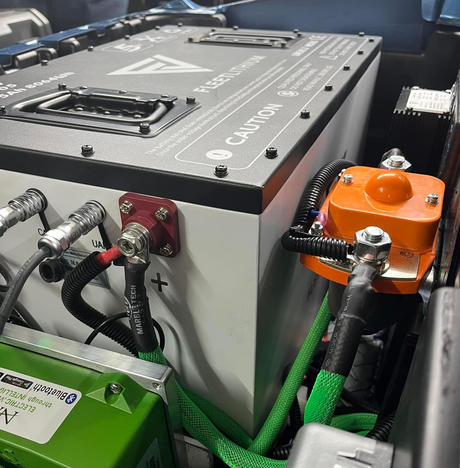
Use correctly rated cables, protection and the specified terminal stack-up and torque. Verify polarity with a meter. Retain the correct 12V supply and control interfaces. Old wires that tapped only part of the lead-acid bank cannot simply move to the lithium positive or negative terminal.
5. Install the matched charger and display
Mount the charger in its approved protected, ventilated location, secure the inlet and fit the matching display harness. Prevent use of the old lead-acid charger. Preserve charging interlock functions with the approved interface; do not bridge control wiring.
6. Charge, test and record the result
Complete the manual’s pre-power checklist and follow the specified power-up sequence. Check battery status, 12V loads and fault indications. Complete a normal full charge, unplug AC and perform a controlled low-speed test. Verify normal braking, then reinspect mounting and cables. For 210Ah, confirm both packs contribute during charging and driving.
The two checks that deserve extra attention
12V accessories need a 12V supply
Your lights, horn, radio and USB outlets depend on the correct accessory circuit. Check the converter’s full input range, load capacity, enable connection, returns and branch fuses. Never connect a 12V device directly across the lithium pack. Added accessories may need more capacity than the original converter can provide.
Keep regenerative braking and protection intact
Bintelli publishes a Curtis 1232E-family controller manual for Beyond applications. The exact controller model and installed calibration matter. Do not disable regenerative braking or raise protection limits as a blanket conversion step. If braking changes or faults appear during deceleration, stop driving and have the battery/controller combination checked against the approved specification.
Keep it with your cart
Download the Bintelli Beyond installation manual
The nine-page Fleet manual includes real before photos, original diagrams, single- and paired-pack instructions, commissioning checks, troubleshooting and a fillable installation record. Revision 1.0 · FL-IM-BINTELLI-48 · October 9, 2026.
Charging and care after your conversion
Use the supplied lithium charger and follow its completion indicators. At a constant 18A, an empty-to-full calculation is about 3.6 hours for 65Ah, 5.8 hours for 105Ah, 9.3 hours for 168Ah and 11.7 hours for 210Ah. Actual charging can take longer because of balancing, tapering, heating or accessory loads.
Inspect restraint and cables regularly, keep connectors protected and avoid pressure-washing electrical components. Follow the storage instructions for your actual Fleet battery model. Original lead-acid watering, equalization and storage routines do not transfer to the lithium pack.
Bintelli Beyond lithium conversion FAQs
Can a Bintelli Beyond be converted to lithium?
Yes. A compatible Beyond with a verified factory 48V lead-acid system can use the Fleet Lithium 51.2V conversion kit. Match the vehicle, battery tray, controller and accessory supply to the selected kit before installation. Factory-lithium replacement is a separate fitment and interface check.
Does every Bintelli Beyond have eight batteries?
No. Bintelli documents both six- and eight-battery lead-acid examples, and parts editions vary. Read each battery label and count the entire bank. Six 8V batteries or eight 6V batteries in series both total 48V; passenger count alone does not identify your configuration.
Why does a 48V cart use a 51V lithium battery?
Fleet 51V products use a 51.2V nominal LiFePO4 configuration for this compatible 48V vehicle class. The matched charger has a 58.4V output rating. Compatibility also depends on the exact controller, charging interface and accessory converter.
Which capacity should I choose?
The listed choices are 65Ah, 105Ah, 168Ah and paired 210Ah. The 65Ah option is for stock motors and controllers only. Choose reserve for passengers, hills, accessories and charging opportunities; confirm fitment for the exact pack arrangement.
Is the 210Ah option a single battery?
No. It uses two matched 51.2V 105Ah packs in parallel. Capacity totals 210Ah while nominal voltage remains 51.2V. Use the approved parallel harness, protection and pack-matching procedure. Never wire the packs in series.
Can I keep my old Bintelli charger?
Use the matched CH5618 lithium charger supplied for the kit, rated 58.4V DC and 18A. Prevent accidental use of the old lead-acid charger, and preserve the vehicle charging interlock using the approved interface.
Will my lights and radio still work?
They need the correct 12V supply after conversion. Verify the existing DC-DC converter input range, output capacity, enable wiring and branch protection. The kit listing does not separately identify a replacement reducer. Never connect a 12V load directly across the lithium pack.
Should I turn off regenerative braking for lithium?
Do not disable regenerative braking as a general conversion shortcut. Confirm the controller calibration for the selected pack. If braking changes, faults appear or the pack disconnects on deceleration, stop driving and have the battery/controller combination checked.
Will the original battery gauge show lithium charge accurately?
A lead-acid voltage gauge is not a reliable lithium percentage display. Use the matched Fleet SOC display and supported app. Keep unrelated speedometer, warning and vehicle-control functions intact.
Does this guide cover Nexus or a factory-lithium Beyond?
No. This edition covers the Beyond 48V lead-acid conversion. Nexus, Nemesis, factory-lithium replacements and other voltage systems require their own fitment and electrical-interface instructions.
Build your Beyond around the way you drive
Choose the reserve you need and get the charger, mounting hardware and battery information to support the conversion. Have your model label, current battery-bank photos and controller label ready if you need help selecting the right system.